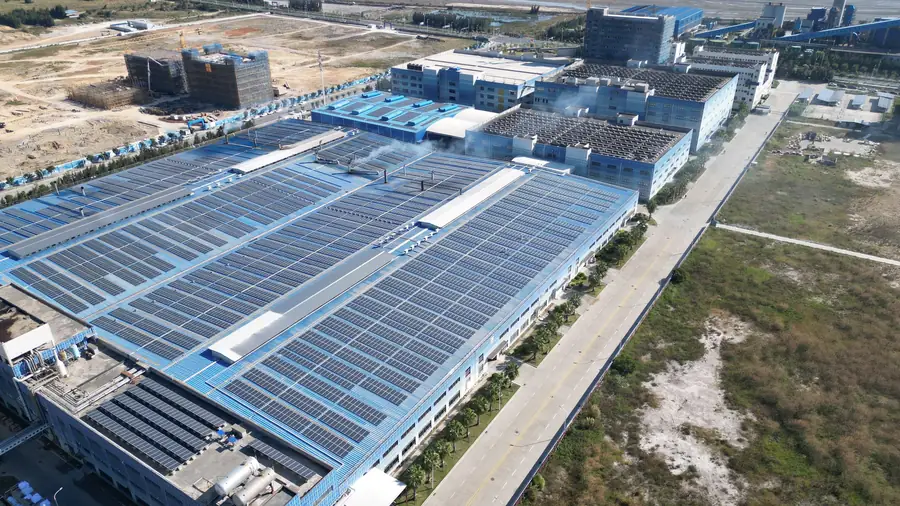
Solar for your working day
Rooftop and ground-mount plants for factories, cold stores, schools and hospitals in Punjab, Haryana, Himachal Pradesh and Chandigarh, sized to your load and hours.
- A factory runs in the day.
- So does the sun.
- Where they overlap, solar is used on site.
- Less drawn from the grid when you use the most.
- Size it to your daytime load.
- Nights and cloudy hours still run on the grid.
Who commercial solar fits
Solar pays best where the electricity is used while the sun is up. Here is how that looks in each kind of building.
| Building | How it uses power | Plan for |
|---|---|---|
| Factories and workshops | Machines run on day shifts, so most of what the plant makes is used on site. | Shift timings, and what runs at night. |
| Cold stores and warehouses | Compressors run round the clock, so solar covers the daytime share of a steady load. | Night load stays on the grid. Batteries are a separate decision. |
| Schools and colleges | The load follows teaching hours, which line up with the sun. | Holidays and summer breaks, when the load drops. |
| Hospitals and clinics | Round-the-clock load with a strong daytime share. | Your backup supply stays as it is. Solar is added alongside it, not in place of it. |
| Offices, showrooms and hotels | Air-conditioning and lighting peak in business hours. | Shade from neighbouring buildings, and roof rights if you rent. |
Sized by your load and your space
A plant is limited by two things: the shade-free area you can give it, and the sanctioned load on your connection. The smaller one sets the starting size.
Count only space that stays out of shade through the day.
Printed on your electricity bill. If it shows kVA, enter that number; we check kW against kVA at survey.
Start from about 100 kW making about 12,000 units a month
This sets your starting size.
Assumptions, not a quote: 100 sq ft of shade-free area per kW and 120 units per kW per month. Net metering and similar arrangements may cap plant size by your sanctioned load or contract demand under the rules your DISCOM applies. We check the real cap for your connection at survey.
What moves the numbers
No payback promise here. Four things decide what a plant is worth to you.
- Fewer daytime units to buy
- Every unit the plant makes while you work is a unit you do not buy. How much that is worth depends on your tariff, which we read from your own bills.
- Accelerated depreciation
- Eligible businesses may be able to claim it on a solar plant. The rules and rates change and depend on your tax position, so ask your CA.
- Demand charges need a careful look
- Solar may not lower the demand (kVA) part of an industrial bill much, because one cloudy hour can still set the peak. We read your bill with you before promising anything.
- Upkeep protects the output
- Dust and droppings cut generation. A cleaning and maintenance plan protects what the plant makes. See care plans.
Metering arrangements
- Net metering
- You use your solar first. The meter records what you export and what you import.
- Gross metering
- All the plant makes goes to the grid under a separate arrangement.
- Behind the meter
- The plant feeds your site only, and no export is planned.
- Punjab (PSPCL) Net metering under the PSERC rooftop solar regulations; a PSERC order waives application and meter-testing fees for PM Surya Ghar systems.
- Haryana (UHBVN or DHBVN) Net metering under the HERC rooftop solar regulations up to 500 kW per consumer; gross metering above that.
- Himachal Pradesh (HPSEBL) Net metering under the HPERC rooftop solar regulations: up to 10 kW on single-phase and 20 kW on three-phase connections (1 MW at 11 kV); systems up to 10 kW need no feasibility study.
- Chandigarh (CPDL) Net metering under the JERC rooftop solar regulations; surplus units banked at the end of the financial year are credited at the rate JERC approves. Confirm current limits with CPDL.Rooftop solar rule. Rooftop solar has been mandatory for houses on plots of 500 sq yd and above since 2016, and for government, institutional and commercial buildings. Extending it to smaller plots has been proposed.
Which arrangement applies to your connection and size differs and changes. We confirm it at the survey, from the current regulations and your DISCOM.
From survey to a plant on its curve
One team from the first site visit to monitoring, working from our Ludhiana office across Punjab, Haryana, Himachal Pradesh and Chandigarh.

-
Survey
We walk the roof or ground, the meter and the panel room, and collect twelve months of bills.
-
Size
We match plant size to your daytime load, your sanctioned load or contract demand, and the area you can spare.
-
Propose
An itemised proposal and a 3D layout with shading, written so a finance head can read it.
-
Approve
We prepare the DISCOM and nodal agency applications and track them with you.
-
Build
Structure, modules, inverters, cables, protection, testing and handover.
-
Monitor
Generation tracking and a cleaning plan keep the plant on its curve.
Which metering arrangement will I get?
Net metering, gross metering and captive use (behind the meter) are treated differently by each state and each DISCOM, and the rules change. We confirm what applies to your connection in Punjab, Haryana, Himachal Pradesh and Chandigarh at the survey, from the current regulations and your DISCOM.
Can the plant be bigger than my roof?
Yes, if there is ground or a car-park structure with shade-free space, and the approval limits allow it. We cover roof and ground mounting.
Will it run my factory when the grid is off?
No. A grid-tied plant stops when the grid is down, for safety. Running through an outage needs batteries or a hybrid design, which we quote separately.
Do you maintain plants others built?
Yes. Cleaning and care plans cover plants installed by any company. See care plans.
Is the number you give me a quote?
No. Sizing here is an estimate from assumptions. A survey gives you an itemised quote.

Let's put your roof to work.
We survey roofs across Punjab, Haryana, Himachal Pradesh and Chandigarh from Ludhiana. You get an itemised quote, a 3D layout and a clear path through subsidy and net metering.
Jalandhar Bypass, Ludhiana 141088 info@wesicsenergies.com